Sometimes, the Human Element Cannot be Replaced

Something occasionally gets overlooked when evaluating startups, and it’s that the human element remains a necessary value proposition in certain areas, such as sales outreach. This is also especially true in the case of user and market research.
I saw this firsthand back in the summer of 2024. For eight weeks, I worked at a boutique healthcare consulting firm that also focuses on market research for its clients. Market research comes in different types: usually, there is either a qualitative approach, where a practitioner interviews an expert who has agreed to participate, or a quantitative approach, where someone answers multiple survey questions on a device. The firm I worked at excels at both of these approaches.
Now, there are definitely things throughout this process that can be made quicker - the people I worked with that summer said as much. However, the one-on-one interview, where the goal is to extract answers in as human a way as possible, is an art, not a science. I think it’s suboptimal for humans to be replaced in this process.
Let’s not forget the other side of this equation: the interviewees. Will someone be able to put up with an AI interviewer “talking” to them? Will it feel conversational at all? Will the interviewee feel offended? There would almost certainly be some interviewees confused by the technology. And there would also almost certainly be interviewees who decide to leave immediately or during the chat. This would occur at a significantly higher rate than it currently does with human interviewers.
When looking at startups that are trying to automate this user research process, founders certainly make a significant difference. But the general customer sentiment matters.
And because of this, many of the AI startups with the best prospects going forward are in the process of replacing something that is not an art.
We’ve seen this with healthcare startups like Heidi and Brellium. Here’s a good market map from Menlo Ventures:
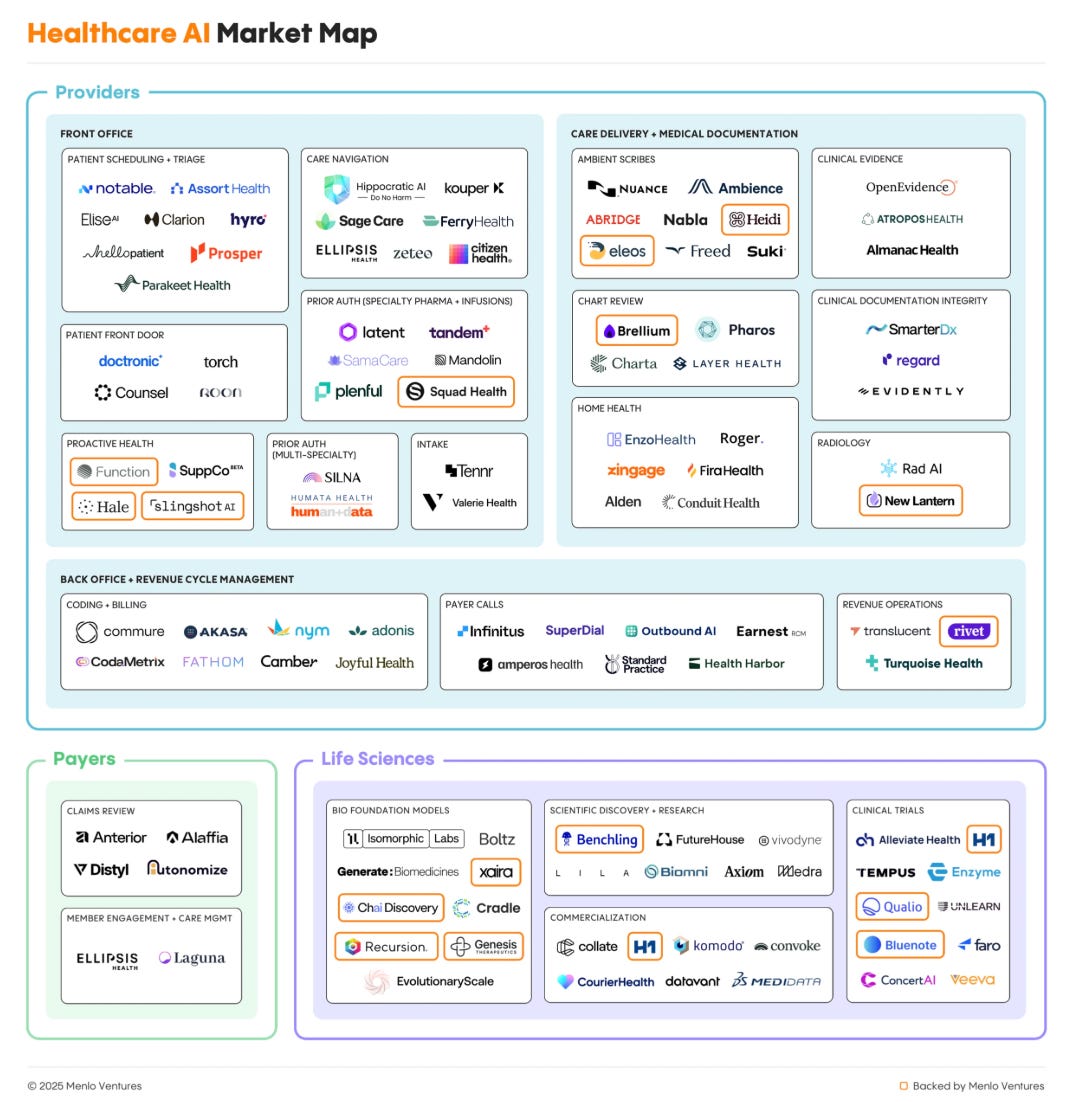
And, going back to customer sentiment, with many consumers becoming more health-conscious, it’s why we’re also seeing growth in consumer health, with companies like Function Health (listed under the “Proactive Health” bucket in the map).
It will be exciting to see how things progress within healthcare and other verticals.
As always, feel free to reach out via email (ryanajayholl@gmail.com) or through LinkedIn.